
November 18, 2026 · 7-min read
How to Study the Bible When You're Battling Insomnia at 3 A.M.
You don't have to choose between lying awake and getting up to worry. There's a third option, and it starts with a few quiet verses.

If you're awake at 3 a.m. searching for Bible verses to read when you can't sleep, start here: Psalm 4:8, Psalm 56:3, and Psalm 127:2 are good places to land, because each one speaks directly to fear, sleeplessness, or trust in the dark. You don't need a full study plan at this hour. You need a few true words to hold onto until your mind settles.
Insomnia has a way of turning quiet hours into worry hours. The question isn't how to force sleep. It's what to do with your mind while you wait for it.
Why does my mind race worse at night?
Nighttime worry feels louder partly because it is uninterrupted. During the day, tasks and conversations crowd out anxious thoughts. At 3 a.m., there's nothing competing for your attention, so the same three worries loop over and over.
This isn't a sign of weak faith. It's a very human pattern, and scripture doesn't pretend otherwise. The psalms are full of nighttime distress:
- "I am weary with my groaning; all the night make I my bed to swim; I water my couch with my tears" (Psalm 6:6).
- "My soul is full of troubles... I remember thee upon my bed, and meditate on thee in the night watches" (Psalm 77, Psalm 63:6).
The writer of those lines wasn't ashamed to say he couldn't sleep. He also didn't stop there. He turned the wakefulness toward God instead of just enduring it.
What verses should I read at 3 a.m.?
Keep a short list ready so you don't have to think or search when your mind is foggy. A few reliable ones:
- Psalm 4:8 — "I will both lay me down in peace, and sleep: for thou, Lord, only makest me dwell in safety."
- Psalm 56:3 — "What time I am afraid, I will trust in thee."
- Psalm 127:2 — "It is vain for you to rise up early, to sit up late... for so he giveth his beloved sleep."
- Psalm 91:1-2 — "He that dwelleth in the secret place of the most High shall abide under the shadow of the Almighty... my God; in him will I trust."
- Philippians 4:6-7 — "Be careful for nothing; but in every thing by prayer and supplication with thanksgiving let your requests be made known unto God. And the peace of God... shall keep your hearts and minds."
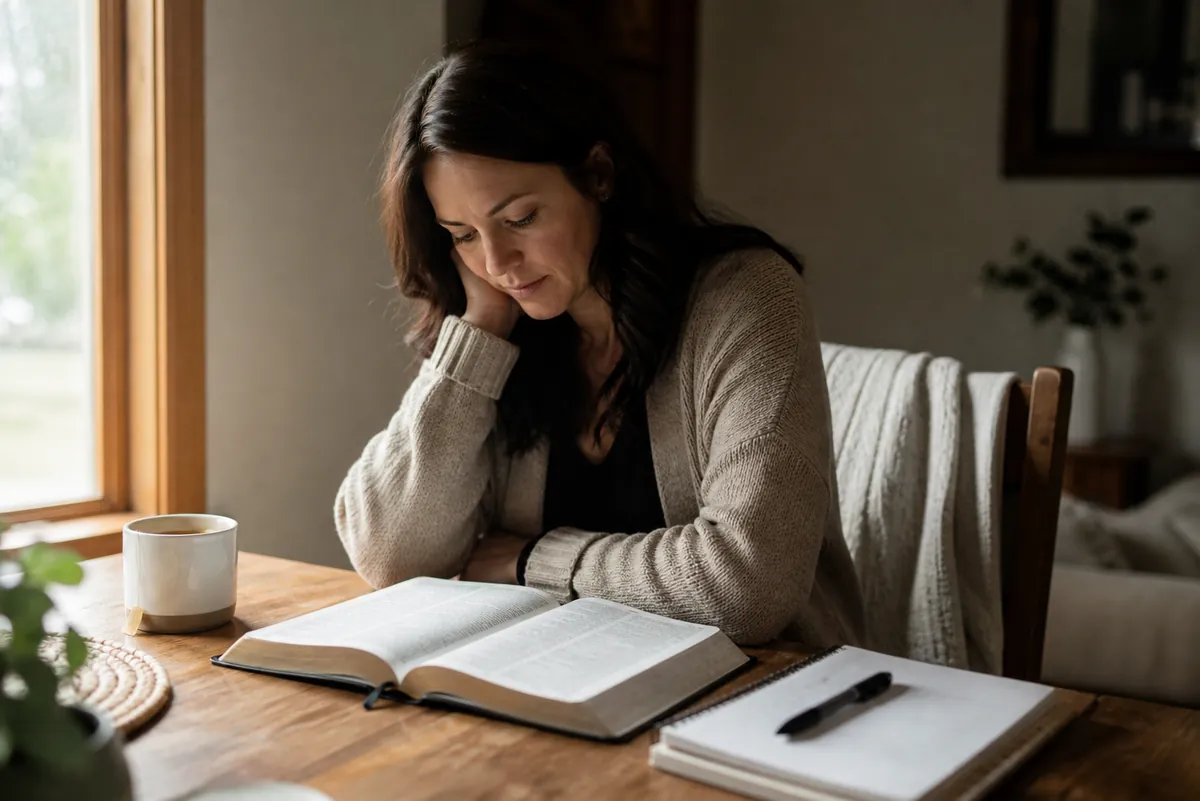
Write two or three of these on a card and keep it on your nightstand. You want something your eyes can find without turning on a bright light or reaching for your phone.
How do I turn insomnia into quiet time instead of worry?
The shift isn't complicated, but it does take a little intention when you're groggy. Try this simple order:
- Name what's keeping you awake. Silently or in a whisper, say the actual worry. Naming it stops it from running loose in the background.
- Read one short passage. Choose from the list above, or open to Psalm 23 or Psalm 91. Read slowly, out loud in a whisper if that helps you focus.
- Hand the worry over in a sentence. You don't need eloquent words. "Lord, I can't carry this tonight, please carry it" is enough.
- Let your mind rest on one phrase, not the whole problem. Repeat something like "he giveth his beloved sleep" quietly as you lie back down.
This isn't a trick to manufacture sleep. It's a way of placing your attention somewhere steadier than the loop of worry, which often is what allows sleep to come back on its own.
What should I keep by my bed for nights like this?
A small, low-effort setup removes the excuse to just scroll your phone instead. Consider keeping these within reach:
- A pocket Bible or a dedicated nightstand Bible, so you're not relying on a glowing screen
- A small notebook for jotting the worry down so you can let it go until morning
- A short list of verses, written out, for nights when your eyes are too tired to search
- A dim book light or small lamp, rather than an overhead light
None of this needs to be elaborate. The goal is friction-free access to scripture at the exact moment your mind is most likely to spiral.

What if I'm wide awake for a long time?
Some nights, a few verses and a prayer won't bring sleep quickly, and that's worth planning for rather than fighting.
- Resist the urge to check the time repeatedly. It only sharpens the anxiety about not sleeping.
- If lying still becomes unbearable, sit up with a small light and read one full psalm slowly, treating it almost like a short, unhurried quiet time rather than a chore.
- Write down any racing thoughts in a notebook, even in fragments. Getting them out of your head and onto paper often loosens their grip.
- Pray for specific people instead of your own worries for a few minutes. Shifting the focus outward can quiet an inward spiral.
If sleeplessness becomes a frequent pattern rather than an occasional night, it's worth mentioning to a doctor. Scripture can steady your heart in the moment; it isn't a substitute for care your body may need.
Where can I go deeper on this during the day?
The middle of the night is not the time for deep study, it's the time for a few anchoring verses and a short prayer. But the anxiety that surfaces at 3 a.m. often has roots worth examining in daylight, when your mind is clearer.
If worry is a recurring companion for you, not just at night, it may help to spend some unhurried daytime hours working through what scripture actually says about fear and anxiety, rather than only reaching for a verse in crisis moments. Our post on what the Bible says about anxiety is a good starting point, and if mornings are just as hard to carve out as nights, this lunch-break method can help you find small pockets of quiet time during the day instead.
For a slower, more structured look at anxiety across several weeks, some women have found it helpful to work through a guided topical study rather than piecing together verses on their own at midnight. Our Anxiety and God's Peace topical study for women was written with exactly these restless nights in mind, walking through scripture on fear and trust at a pace you can actually sustain. You can browse other quiet time resources and study guides as well if you're looking for something to anchor your mornings too.
Whatever tonight looks like, you're not failing by being awake. You're simply being given hours that most people sleep through, and scripture has quietly met people in those same hours for a very long time.
Frequently asked questions
- What Bible verse helps with insomnia?
- Psalm 4:8 is a common choice because it directly connects sleep with safety in God, and Psalm 127:2 reminds the reader that rest itself is something God gives, not something earned by staying up to fix everything.
- Is it a sin to worry at night and not be able to sleep?
- No. Insomnia is not a moral failure, and plenty of faithful people in scripture stayed awake in distress. The goal is not guilt, it is bringing the wakefulness to God rather than carrying it alone.
- Should I turn on a light to read my Bible at 3 a.m.?
- A small, dim light is usually fine and will not hurt your chances of falling back asleep as much as a bright overhead light or a phone screen would.
- How long should a middle-of-the-night Bible reading be?
- Keep it short, just a few verses or one short psalm. The point at 3 a.m. is not a full study session, it is settling your mind enough to rest again.
- What if I fall asleep in the middle of praying or reading?
- That is a good outcome, not a failure. Falling asleep while your mind is on scripture or prayer is simply a different, equally real way of resting in God.
- insomnia
- quiet time
- bedtime prayer
- anxiety
- bible verses
- night prayer
Related reading
- Armor of God Bible Study for Women: A 4-Week OutlineA simple armor of god bible study for women: four weeks through Ephesians 6:10-18, with discussion questions and practical ways to apply each piece.
- How to Study the Bible When You're Grieving a PetBible verses for grieving a pet, plus a simple quiet-time approach to bring real grief over an animal companion honestly before God.
- How to Study the Bible When You're Grieving a Breakup, Not a DeathBible verses for grieving a breakup, plus a simple quiet-time approach for the kind of grief that doesn't feel 'big enough' to talk about.