
July 24, 2026 · 7-min read
How to Study the Bible with Someone Who Grieves Differently Than You
Grief rarely moves at the same pace for two people in the same room, and that is exactly why your study together needs a gentler shape.

A bible study for grief works best when you stop trying to make two people grieve the same way and instead build a study around whichever way each person actually processes loss. Some people want words and structure. Others need silence and space. Both can meet God in scripture, just not on the same schedule.
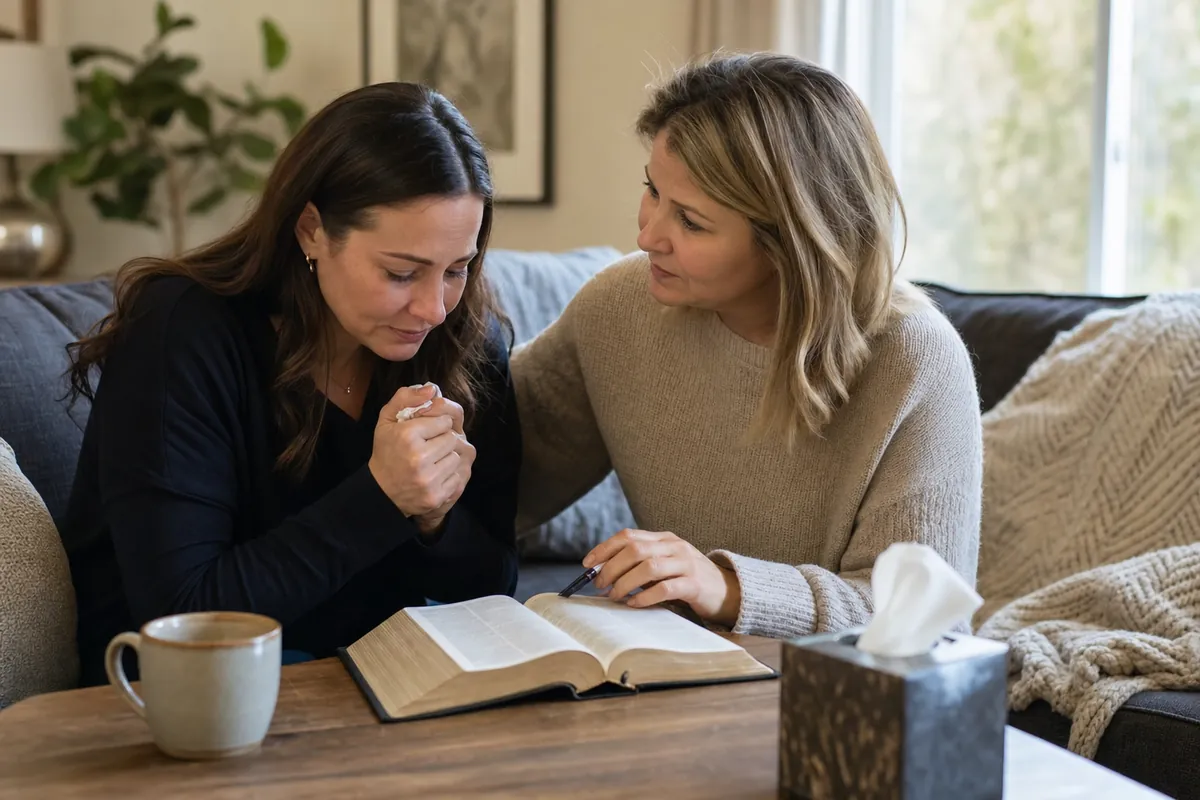
This matters most in small groups and families, where one person's way of grieving can quietly make another person feel unseen. If you lead a group or simply want to sit with someone you love, the goal is not to fix their grief. It is to open scripture in a way that has room for however they carry it that day.
Why do people grieve so differently?
Grief is shaped by personality, faith background, and how loss actually happened, not just by how much someone loved what they lost.
- Processors think out loud and want to talk through every detail.
- Internalizers need quiet and privacy before they can put anything into words.
- Doers cope by staying busy and may resist sitting still for a study at all.
- Feelers move through waves of emotion and may cry, laugh, or go numb within the same hour.
None of these are wrong. Job's friends sat with him in silence for seven days before anyone spoke (Job 2:13), and that silence is treated in scripture as the right first response, not a failure to help.
How do I choose a passage that fits both grieving styles?
Choose short, honest passages over long doctrinal ones. Grief narrows a person's attention, so a study that leans on one clear verse works better than a chapter with six sub-points.
A few dependable starting places:
- Psalm 34:18 — "The LORD is nigh unto them that are of a broken heart; and saveth such as be of a contrite spirit." Good for the person who needs to know God is close, not distant, in sorrow.
- Psalm 23 — Familiar enough to recite from memory when words are hard to find, which helps the internalizer who cannot generate fresh thoughts on demand.
- John 11:32-36 — Jesus weeping at Lazarus's tomb, useful for showing that grief and faith are not opposites.
- Lamentations 3:19-24 — Moves from despair to hope within a few verses, which mirrors how grief actually moves rather than a straight line.
Pick one passage per session rather than several. A grieving person's capacity is smaller than usual, and a study that respects that will be more welcome than one that tries to cover ground.
What questions actually work in a grief-focused study?
Open-ended, low-pressure questions let each person answer in their own way, whether that is three sentences or three words.
- "What part of this passage feels true to you right now?"
- "Is there a line here you want to sit with a little longer?"
- "Does anything here feel hard to accept today, and is that okay to say out loud?"
- "Would you rather talk about this or just read it together in quiet?"
Avoid questions that assume a single correct emotional response, such as "Doesn't this bring you peace?" A processor may say yes readily. A feeler having a hard day may feel pressured to lie.
How do I lead a group with mixed grieving styles?
Give people options rather than one required format. Say plainly at the start of the session that talking is welcome and so is silence, and that no one needs to explain which one they will choose.
A workable structure:
- Open with a short prayer, not an icebreaker. Icebreakers can feel jarring against grief.
- Read the passage aloud once, slowly.
- Offer a few minutes of silent reflection before any discussion begins.
- Ask one open question, and let the room decide how much to say.
- Close in prayer, naming the loss if it feels appropriate, without demanding anyone respond.
If you're building out a fuller session plan or deciding what to study next, how to choose the right Bible study topic for your group has a practical framework for narrowing options without losing sight of what your group actually needs right now.
What if someone doesn't want to talk at all?
Let them not talk. Presence without pressure is still ministry, and scripture models this well. Sometimes reading a passage aloud together and simply closing in prayer is the whole session, and that is enough.
For the person who processes through writing rather than speaking, a private option can help more than a group discussion. Writing out a verse, or writing a short, honest prayer in response to it, gives an internalizer a way to engage without performing emotion for the room.

How do I handle grief that includes anger at God?
Let it be said out loud, and go to scripture that already says it. The Psalms of lament exist precisely for this. Psalm 13 opens "How long wilt thou forget me, O LORD? for ever?" without apology, and it is still counted as prayer.
Naming this before you start can lower the fear of saying something "wrong": there is no wrong way to bring grief to God, only honest ones. If a group member's grief has stretched into a longer season of waiting, on God, on healing, on answers that haven't come, that waiting itself can become something to study rather than something to rush through.
For a woman walking that kind of long, uncertain stretch, a focused resource can help more than another general discussion guide. Trusting God in Waiting Seasons was written as a topical study for exactly that in-between space, when grief and waiting overlap and a person needs scripture to sit with rather than answers to perform. It's worth a look if that describes where you or someone in your group is right now, alongside the wider collection in the shop if you're building out a fuller season of study together.
A closing thought
You will not get every session right, and that is not the measure of whether this was worth doing. What grieving people tend to remember is not the perfect question, but that someone stayed in the room, opened scripture honestly, and let them grieve at their own pace while pointing gently back to God the whole time.
Frequently asked questions
- What is the best Bible study approach for someone who is grieving?
- There is no single best approach, but shorter passages, open-ended questions, and permission to sit in silence tend to serve grieving hearts better than fast-paced discussion formats.
- Should I bring up Bible study with a grieving friend or wait for them to ask?
- A gentle, low-pressure invitation is usually welcome, as long as you make clear there is no obligation to attend or to talk if they are not ready.
- What Bible verses help with grief and loss?
- Psalm 34:18, Psalm 23, Matthew 5:4, and John 11:35 are commonly turned to because they name sorrow honestly rather than rushing past it.
- Is it okay to study the Bible with someone who is angry at God because of their grief?
- Yes. Scripture itself contains honest, even angry, prayers of lament, and studying those passages together can help someone see that raw honesty with God is not a failure of faith.
- How long should a grief-focused Bible study session last?
- Fifteen to twenty-five minutes is often enough, since grief can be tiring, and it is better to end while there is still emotional capacity than to push through exhaustion.
- grief
- bible study
- small groups
- quiet time
- comfort
- mourning
Related reading
- How to Study the Bible When You're a New Mom with No Free TimeA bible study for new moms with no time doesn't need a free hour. Here are short, realistic ways to meet God between feedings and naps.
- How to Study the Bible with a Study Bible's FootnotesLearn how to use study Bible footnotes and cross-references without feeling overwhelmed, with a simple step-by-step approach for quiet time.
- How to Study the Bible When You're Going Through a DivorceA gentle, practical guide to bible study for women going through divorce, with simple steps for quiet time when your heart and schedule are in pieces.