
July 27, 2026 · 7-min read
How to Take Sermon Notes You'll Actually Reread Later
You do not need to write down everything the pastor says. You need to write down the right things, in a way you will actually want to revisit.

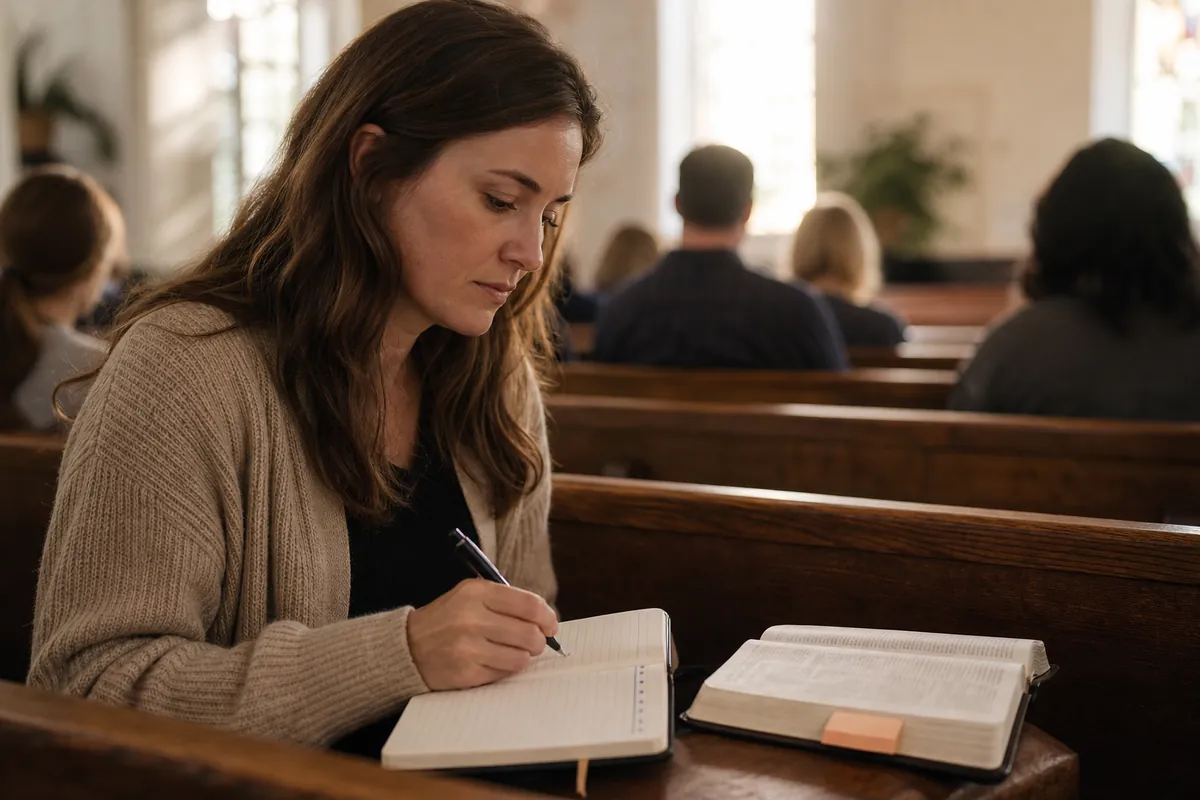
How to take sermon notes you will actually reread starts with writing less, not more. Instead of transcribing everything the pastor says, capture the main point, one supporting verse, and one honest application question, in that order, every single week.
Most of us have a drawer, a phone folder, or a stack of church bulletins covered in notes we never look at again. That is not a discipline problem. It is a format problem. If your notes are a wall of half-finished sentences, of course you will not reread them. But a short, consistent structure turns Sunday morning notes into something you actually reach for on Wednesday.
Why do most sermon notes go unread?
Sermon notes usually fail for one of three reasons.
- Too much volume. A full page of scattered phrases is hard to scan later and easy to set aside.
- No structure. Without a consistent format, every week's notes look different, so your eye has nothing familiar to land on.
- No follow-up plan. If nothing tells you to open the notebook again, it simply closes and stays closed.
The fix is not more effort. It is a simpler, repeatable shape that makes reviewing feel quick rather than like homework.
What should sermon notes actually include?
A useful sermon note fits comfortably on one page and answers four short questions. You do not need all four every week, but keeping the same categories builds a habit your eye recognizes.
- Main idea – one sentence for what the sermon was actually about.
- Key verse – the one passage the message kept returning to.
- Something new – a phrase, illustration, or insight you had not considered before.
- One application – a specific, small way to live differently this week.
That is the whole system. Four short lines beat four pages every time, because your future self can scan it in under a minute.
How do I take notes without missing the sermon itself?
The goal of sermon notes is not a transcript. It is a memory hook. Try these habits during the message.
- Write the verse reference the moment it is given, before the explanation starts.
- Wait until a thought is fully spoken before summarizing it in your own words.
- Leave blank space rather than cramming, so the page stays easy to read later.
- Underline or star only the one line that felt most personal, so it is easy to find again.
If you find yourself writing instead of listening, that is a sign to slow down. Proverbs 4:20 says, "My son, attend to my words; incline thine ear unto my sayings." Attending well matters more than recording everything.
What is a simple weekly template to copy?
If a blank page feels intimidating, use this short template at the top of your notes each week.
Date: Passage: Main idea: Verse that stood out: Something new I learned: One way to apply this:
Fill in only what applies. Some weeks you will have a full application; other weeks just a verse worth sitting with is enough. The consistency of the format, not the amount of writing, is what makes these notes worth returning to.
When should I actually reread my notes?
A note-taking system only pays off if you build in a review moment. Pick one that fits your week rather than adding pressure.
- Sunday evening, while the sermon is still fresh, to reread and add anything you missed.
- During your daily quiet time, folding last week's application point into your prayers. If you already have a rhythm here, a daily quiet-time habit is the natural place to plug this in.
- Before the next Sunday, so you can notice patterns across weeks or themes your pastor keeps returning to.
Even one of these check-ins turns a page of notes into something that shapes your week, rather than a page that simply gets filed.

How can I remember the sermon, not just record it?
Writing something down is not the same as remembering it. If a particular verse or idea really struck you, it is worth carrying further than the notebook page.
- Say the key verse aloud once before you leave for the day.
- Mention the main idea to a spouse, friend, or small group during the week.
- Revisit the verse using a method like the ACTS prayer method to turn it into a short prayer rather than just a memory.
- If a verse keeps surfacing, consider working it into scripture memory using an approach from how to memorize scripture when you're not good at memorizing.
These small steps move a sermon from something you heard once to something that actually shapes how you think and pray.
What kind of notebook works best for this?
Any notebook works, but a dedicated one helps more than a loose stack of bulletins or scattered phone notes. Having a consistent place with the same simple prompts each week removes the friction of deciding what to write and where.
Some women in our community use the Women's Bible Study Notes Journal — Physical Edition for exactly this purpose. It gives you the same short prompts each week, so Sunday notes stay quick to fill in and quick to reread later. If you are looking for other study resources, our full shop has journals and guides built around the same idea of keeping things simple and reusable.
Sermon notes do not need to be impressive. They need to be honest, short, and easy to find again. A single sentence about the main idea, one verse, and one small way to apply it will serve you far better a month from now than three pages you never open.
Frequently asked questions
- Should I take sermon notes on paper or on my phone?
- Paper tends to work better for most women because it removes the temptation to check messages mid-sermon and it forces you to summarize rather than transcribe. If you do use a phone or tablet, keep it in a dedicated notes app or Bible app and turn off notifications first.
- How much should I actually write during a sermon?
- Aim for a handful of short lines rather than full sentences. A single page with one main point, one verse, and one application is more useful later than three pages of scattered quotes.
- What if I miss part of the sermon while writing?
- Write less, not more. If note-taking is pulling your attention away from listening, switch to jotting only the verse references and one or two key words, then fill in your own thoughts afterward.
- How do I actually go back and use old sermon notes?
- Set a short recurring time, such as five minutes on Sunday evening or during your weekday quiet time, to reread the previous week's notes and check whether you followed through on the application point.
- Should sermon notes and quiet time journaling go in the same notebook?
- Many women prefer to keep them together so the whole week's spiritual reflection is in one place, while others keep sermon notes separate to protect a distraction-free page for daily journaling. Either works as long as you know where to look for both.
- sermon notes
- quiet time
- bible study habits
- note-taking
- spiritual growth
Related reading
- How to Study the Bible When You're a New Mom with No Free TimeA bible study for new moms with no time doesn't need a free hour. Here are short, realistic ways to meet God between feedings and naps.
- How to Study the Bible with a Study Bible's FootnotesLearn how to use study Bible footnotes and cross-references without feeling overwhelmed, with a simple step-by-step approach for quiet time.
- How to Study the Bible When You're Going Through a DivorceA gentle, practical guide to bible study for women going through divorce, with simple steps for quiet time when your heart and schedule are in pieces.