October 9, 2026 · 7-min read
How to Study the Bible with a Highlighting System That Works
A few colors, used the same way every time, can turn your Bible into a map of everything God has shown you.

A Bible highlighting system is a short, consistent set of colors you use every time you read, so that promises, commands, and warnings are easy to spot and find again later. Pick four to six colors, assign each one a single meaning, and apply it the same way across every book of the Bible you study.
That consistency is the whole secret. Most women who try highlighting give up not because the idea fails, but because the system keeps changing. One week yellow means a promise, the next week it means something that stood out. Six months later, opening the Bible to a highlighted page tells you nothing at all.
A good system should do the opposite. It should let you flip to Romans 8 or Psalm 23 and instantly remember what God showed you there, even years later.
What makes a highlighting system actually work?
A working system has three qualities: it is simple, it is consistent, and it is written down somewhere you can check.
Simple means you are not juggling twelve colors and trying to remember the difference between "important" and "very important." Consistent means a color means the same thing in Genesis that it means in Revelation. Written down means you have a key, so six months from now you are not guessing.
Here is a starter key many women find useful:
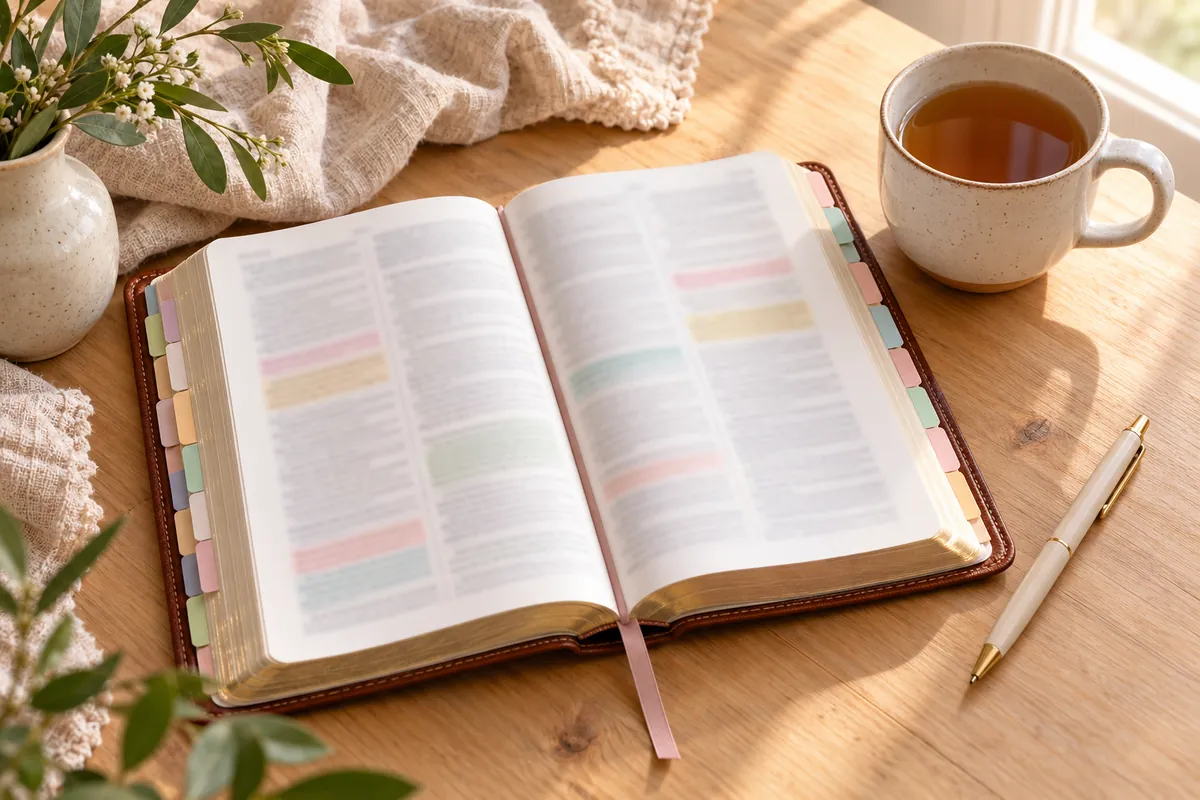
- Yellow — promises of God
- Blue — commands or instructions
- Green — God's character or names
- Pink or red — warnings or sin to avoid
- Purple — verses about prayer or worship
- Orange — personal application, something you want to remember or act on
You do not need all six right away. Many women start with three colors and add more only when they feel a real gap.
How do I choose which colors to use?
Choose colors that make intuitive sense to you, since you are the one who has to remember them. Some women use yellow for promises because sunlight feels hopeful. Others use red for warnings because it is the universal color for caution.
A few practical tips:
- Keep your palette small at first. Three colors used faithfully beats six colors used halfheartedly.
- Avoid using a color for more than one meaning. If blue means both commands and comfort, you will eventually confuse yourself.
- Write the key somewhere permanent, such as the inside front cover of your Bible, a bookmark, or the first page of your prayer journal.
- Test your pens on a blank page first. Many Bible papers are thin, and ink can bleed through even "fine tip" markers.
If you study with a group, it also helps to ask whether others want to use the same key. Shared color systems make group discussion easier, since everyone can reference "the blue verse" and know exactly what is meant.

What should I actually mark as I read?
Once your key is set, the next question is simply: what counts? A practical rule is to mark only what fits cleanly into one of your categories, and leave the rest of the text alone.
For example, reading through the first chapter of 1 John, you might mark:
- "That which was from the beginning, which we have heard, which we have seen with our eyes" — a statement of who Christ is, in green
- "If we confess our sins, he is faithful and just to forgive us our sins" (1 John 1:9, KJV) — a promise, in yellow
- "Walk in the light, as he is in the light" — a command, in blue
Notice that not every verse gets marked. Resist the urge to highlight entire paragraphs. A page that is mostly one color teaches you nothing; a page with a few careful marks becomes a map you can scan in seconds.
A helpful habit is to pause after each chapter and ask: "What here is a promise I can stand on, a command I need to obey, or something true about God I want to remember?" That one question does most of the sorting work for you.
How does this fit into a daily quiet time?
Highlighting works best as part of a steady rhythm, not a one-time project you try to apply to the whole Bible at once. If you are still building that rhythm, a daily quiet-time habit that sticks is worth reading alongside this system, since the two support each other well.
A simple daily flow might look like this:
- Read the passage slowly, once without a pen in hand.
- Read it again, this time marking with your color key.
- Write one sentence in your journal about what you marked and why.
- Pray briefly over whatever you highlighted that day.
That third step matters more than it seems. The color tells your eye where to look later, but the written sentence tells your heart what it meant in the moment. Together they turn a quick quiet time into something you can return to months from now.
What if I don't want to mark up my Bible?
Some women love a clean, unmarked Bible, and that is a fine preference, not a failure. If that is you, the highlighting system still works, just move it to paper.
Keep a simple page in your notebook with four or six columns, one per color category, and jot the verse reference under the right column as you read. You lose the visual at-a-glance effect inside the Bible itself, but you gain the same searchable structure, and your Bible stays untouched.
This paper-based approach pairs naturally with a dedicated study journal, since you already need somewhere to write the verse, the category, and a short note about why it stood out. A notes journal built for exactly this kind of daily marking, like the Women's Bible Study Notes Journal, gives you that structured space without having to design a tracking page from scratch. It is one option among several in the shop, and far from the only way to keep this system running. What matters most is simply that you have somewhere consistent to return to.
A system worth keeping
The best highlighting system is not the most elaborate one. It is the one you still remember and still use a year from now, when you open to a familiar passage and see, in your own handwriting and your own colors, exactly what God showed you the first time you read it there.
Frequently asked questions
- What colors should I use in a Bible highlighting system?
- Most women do well with four to six colors, each tied to one category such as promises, commands, or God's character. Fewer colors used consistently will serve you better than many colors used inconsistently.
- Will highlighting damage thin Bible pages?
- Standard highlighters often bleed through thin Bible paper, so it helps to use pens or pencils made for Bible journaling, or test a hidden page first. Many women also keep notes in a separate journal instead of marking the Bible itself.
- How do I remember what each color means?
- Write your color key on an index card or the inside cover of your Bible so you can check it until it becomes second nature. Keeping the key visible for the first few weeks makes the biggest difference.
- Is it wrong to mark up my Bible?
- No, marking your Bible is simply a study tool, not an act of reverence or irreverence. What matters is that the practice helps you return to what God has shown you, not how the pages look.
- bible study methods
- bible highlighting
- quiet time
- scripture marking
- bible study tips
Related reading
- How to Write a Bible Study Guide for Your Small GroupLearn how to write a Bible study guide for your small group, step by step, with a simple structure you can reuse week after week.
- How to Study the Bible in a Small Group When You're ShyBible study tips for shy, introverted group members who want to engage meaningfully without feeling pressured to speak up on cue.
- How to Study the Bible with a Reading Plan That Actually Fits Your LifeA realistic bible reading plan for beginners: how much to read, what to include, and how to keep going when life gets busy.